Introduction

Downtown Wichita Falls, Texas, in the mid 1940’s was a bustling metropolis for a boy of 7 just away from the farm and ranch community where he was born. My father, a cook and cowboy by trade, had just started as one of the first cooks for the Casa Manana restaurant in 1947. He moved us to an apartment on Ohio Street, right across from the Gem Theater, between 7th and 8th Streets. It’s here that we would stay for the next three years. The Gem Theater became a magic palace for a young mind. But it had to share that distinction with the rest of the magic that was Wichita Falls. I attended San Jacinto and Carrigan elementary schools, as well as Reagan Junior High, and belonged to the Boys Club on 6th Street. Please join, and share your stories and pictures through a Guest Blog, of early Wichita Falls - or your home town. Contact me at fadingshadows40@gmail.com or leave a comment. We could use old pictures of movie houses, drive-in theaters, and other nostalgic pictures related to our youths.

Showing posts with label Saturday Matinee Serials. Show all posts

Sunday, November 30, 2014

Rocketman

Rocketman


I saw King of The Rocketmen in 1949, and I’m sure it was at the Gem Theater.  Released in 1949 from Republic, as a 12-chapter serial, it starred Tristram Coffin as Jeff King/Rocketman, and Glenda Thomas as Mae Clarke. It was the only Rocketman serial I would see as a child, but I loved it. I even tried to build my own rocket pack out of paper and glue; thankfully, I didn’t kill myself.


Radar Men From The Moon was a 12-chapter serial released in 1952, this time starring George Wallace as Commando Cody, and Aline Towne as Joan Gilbert. The great Roy Barcroft played the villain, Retik. This one, and the rest I would see as an adult when I started collecting the serials many years later.


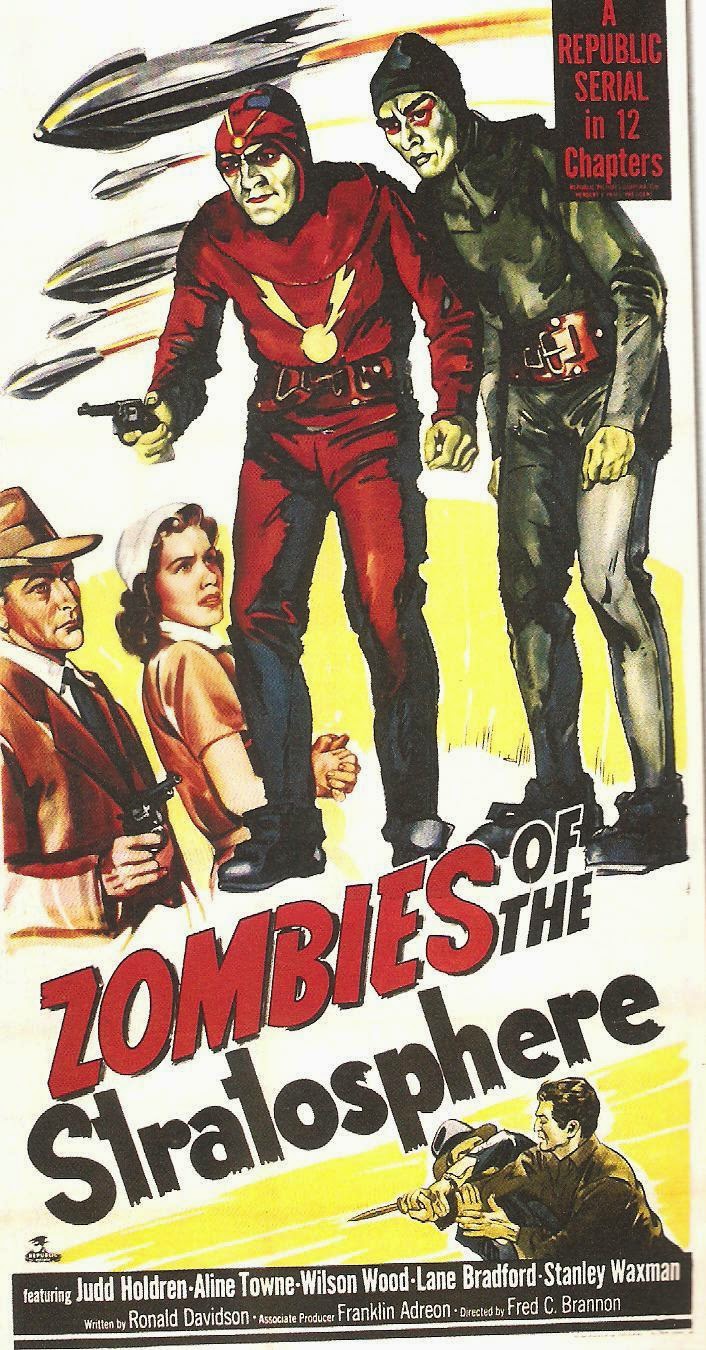
Zombies of the Stratosphere was released later that same year, again in a 12-chapter serial, this time starring the third actor, Judd Holden to portray Rocketman/Larry Martin. Aline Towne plays Sue Davis instead of Joan Gilbert this time. A young Leonard Nimoy played one of the “zombies”.


A final Rocketman/Commando Cody was filmed for theater release in 1953, and later was released to television in 1955, where it played out in 12-episodes. Sky Marshall of The Universe also starred Judd Holden as Larry Martin. Aline Towne returns as Joan Gilbert. His sidekick this time around is William Schallert for the first few episodes before being replaced.

Saturday, August 9, 2014

Blackhawk

Blackhawk
Blackhawk was a flying squadron of World War II veterans, The International Brotherhood is a private flying investigative force led by Blackhawk (Kirk Alyn). They uncover a gang of underworld henchmen, led by the notorious foreign spy, Laska (Carol Forman), who reports to a mysterious man called The Leader. During the 1952 serial's 15 chapters, Blackhawk and his flying squadron set about bringing these criminals to justice. Kirk Alyn and Carol Forman has previously starred in the 1948 Superman serial.


Blackhawk was first published in comic books, and was very popular in that media, appearing in numerous titles, as well as his own.


In 1982, Warner Paperbacks released a Blackhawk paperback written by William Rotsler, which everyone hoped would be a series like Flash Gordon and The Phantom at that time, but it was destined to be just a single title.

Wednesday, January 22, 2014

The Phantom Detective


The Phantom Detective

After the debut of The Shadow in 1931, pulp publishers were scrambling for a hero title to match The Shadow’s popularity with readers. The first to arrive on the stands was The Phantom Detective in 1933. At first, STREET & SMITH yelled lawsuit, as they thought the new character from STANDARD was a blatant rip off of their character. But before the ink was dry, POPULAR PUBLICATIONS had The Spider & Operator #5 and ACE had Secret Agent X as their leads. The pulp heroes were taking the public by storm and The Shadow was no longer alone.
Spinner Rack With Phantom Detective Pulps


Although The Phantom Detective did not have as many issues as The Shadow, it did outlast the Master of Darkness in number of years. The Shadow ran from 1931 to 1949, with 325 stories, a total of 18 years. The Phantom Detective only            had 171 issues, but lasted 20 years, from 1933 to 1953, and became the longest-running hero title in the pulp magazines.
Phantom Detective Paperback


Some even argue that The Phantom Detective actually lasted longer than the official record indicates. In 1932 STANDARD ran a serialized novel in one of their pulp magazines titled Alias Mr. Death by G. Wayman Jones (D.L. Champion). Mr. Death was merely retooled to become The Phantom Detective. If that wasn’t enough, researchers of also discovered numerous rejected Phantom Detective stories that were published as other characters, so the 171 may someday be altered. And it gets even murkier than this. One of the Doc Savage authors took his unpublished Doc Savage yarns and turned them into Phantom Detective stories. And one more curiosity, a final Phantom Detective author was also writing Shadow radio scripts, and in one of his Phantom Detective yarns he accidentally calls him The Shadow. Only in the pulps, right?
Phantom Detective Comic Book
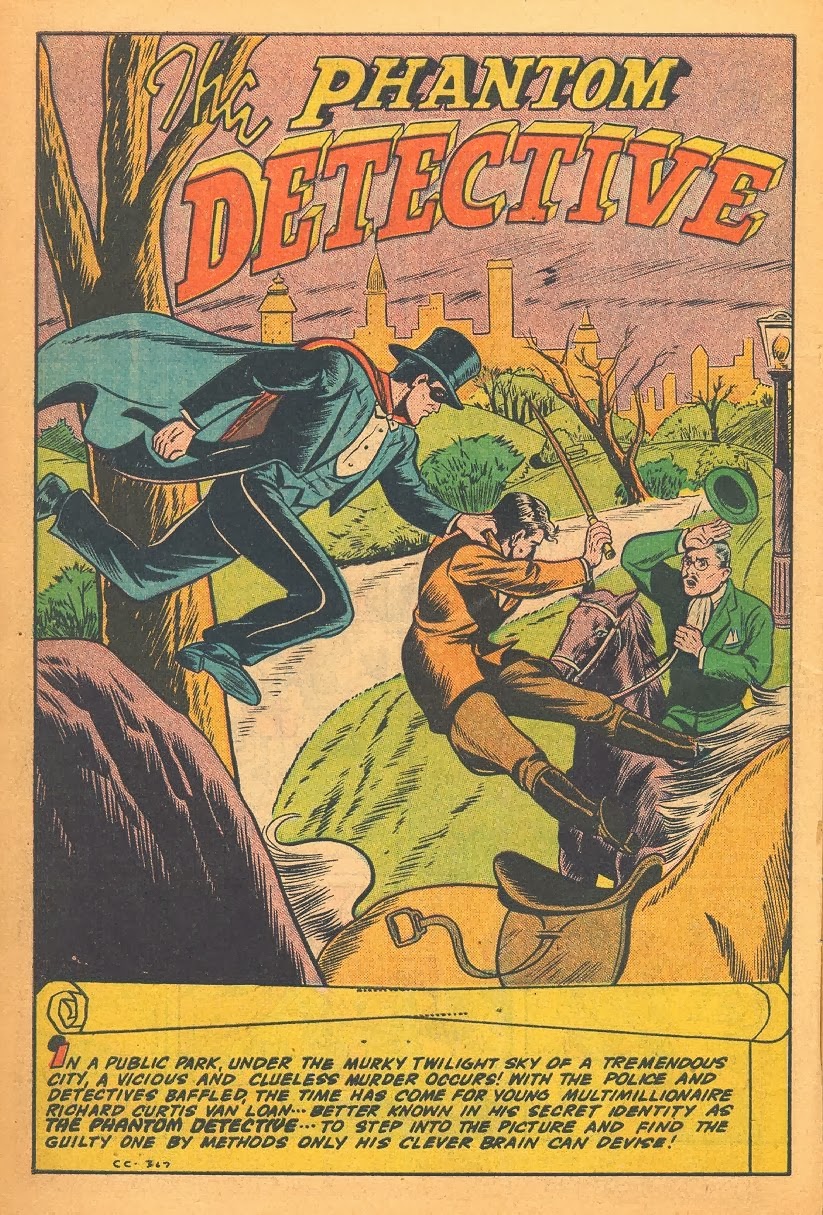

The matinee serials, or chapter plays, at the local theaters drew upon the other media of the day for their popular cliffhangers. There were probably a dozen Zorro serials. Comic Books like Superman, Captain Marvel, Captain America, and others, were made into exciting serials; the pulp characters also had their turn at celluloid fame. The Shadow, The Spider, Tailspin Tommy, G-Men, and many others were made into serials to attract kids to the matinees. So too did the comic strips, like Flash Gordon, Buck Rogers, The Phantom, and Mandrake, and many others. When too much money was asked for the Rights to a character, the producers of serials made up their own characters. Bidding for the first Superman serial in 1940 broke down because of the money Detective Comics wanted for the Rights, so the movie that had already been planned had to change the name of the hero. From Superman, he became The Copperhead, and the serial was The Mysterious Dr. Satan. Comic strips’ The Phantom (The Ghost Who Walks) made one serial and planned a second. The producers decided against the high fee on the second, so the character was changed to Captain Africa. And yes, negotiations were rumored for a chapter play featuring The Phantom Detective, but one never appeared. However, about the time everyone expected this one to show up, a very interesting serial did appear. It was titled The Black Widow, and had all the elements of The Phantom Detective, except for, yep, The Phantom Detective. Still, he was there, even if not in name and appearance. I saw the serial either at the Gem or Tower Theater around 1947.
The Black Widow Serial


The era of the Thirties and Forties was one of the most exciting times for children and young adults looking for escapism. Though the times were harsh, the entertainment was wonderful. Pulps, comic books, picture shows, and serials truly were at the zenith of their achievements for the youth of America. Today’s entertainment, with the sex, extreme violence, and gutter language can never match those simpler times, when the world needed heroes, and children needed someone to look up to, even if they weren’t real, they could be found in their favorite form of entertainment.
Friends of The Phantom ID Card

Friday, November 22, 2013

The Media And The Shadow


The Media And The Shadow

As a child, one of my favorite radio dramas was The Shadow, the mysterious man who could cloud men’s minds and thwart evildoers in a thirty-minute broadcast. The Shadow had an odd beginning. An announcer on Street & Smith’s Detective Hour began calling himself The Shadow, and listeners ran to the newsstands looking for Street & Smith’s Shadow magazine. It didn’t take Street & Smith long to copyright the character by introducing a pulp magazine featuring The Shadow.
The Pulp Shadow by Walter Gibson


Walter Brown Gibson created and wrote the original stories under the Maxwell Grant house name. The pulp Shadow was quite a bit different from the radio Shadow that appeared afterwards. The first novel appeared in 1931. He was a mysterious personage who wore all black – patterned somewhat after Dracula, and could fade into the shadows. He didn’t ‘cloud the minds of men’. But radio was a theater of the mind, while pulp novels presented printed text for readers.
The Comic Book Shadow


         Street & Smith got into the comic books when they saw Superman selling millions of copies. Pulps were lucky to sell 7 or 8 hundred thousand copies, and that was their more popular titles. So in the 1940’s The Shadow made his appearance in comic books and newspaper comic strips. Since 1973, there have been several comic book adaptations of The Shadow, each apparently losing much of the true background of the original character, until modern comic book versions only visually resemble the character created by Walter Gibson in 1931.
         But that wasn’t the end of it. There was a 15-chapter serial from Columbia in 1940 starring Victor Jory. Several minor movies were produced early on, but three late 1940's from Republic proved successful, though somewhat comedic. Even a TV pilot was shot, which thankfully didn’t make it. The 1984 movie starring Alec Baldwin proved fairly successful, though it was a mixture of the pulp and radio Shadow.
Paperback Shadow Novels


         Although the pulp Shadow ran for 325 novels, and was highly popular during the pulp era, for some reason paperback publishers failed to reach out to the character. In 1963, Belmont Books brought out a new series of The Shadow, updating the character to the popular spy rage of the time. Walter Gibson was brought in for the first issue, then Dennis Lynds wrote eight more stories, and the series ended. In 1969, Bantam reprinted the first pulp novel in a new series to run along side their extremely popular pulp hero, Doc Savage. Unfortunately, The Shadow only lasted seven issues. Some blame the covers for its failure. A final paperback series was again brought out in 1974 from Pyramid/Jove, lasting for 23 issues, with some great covers by comic book artist, Steranko. There were some hardback editions that also appeared, but overall, the series just didn’t seem to catch on to modern readers. Tony Tollin, of Sanctum Books, has done better. He has reprinted over 150 Shadow novels in his double novel series, reprinting the novels in facsimile format, including illustrations, and reaching new fans of the character. His goal is to release all 325 Shadow novels.
         The Shadow has reached all media formats, and has been considered one of the most iconic characters ever created in fiction. Yet he appears to remain mysterious to the modern generation.
         A shame.