Introduction

Downtown Wichita Falls, Texas, in the mid 1940’s was a bustling metropolis for a boy of 7 just away from the farm and ranch community where he was born. My father, a cook and cowboy by trade, had just started as one of the first cooks for the Casa Manana restaurant in 1947. He moved us to an apartment on Ohio Street, right across from the Gem Theater, between 7th and 8th Streets. It’s here that we would stay for the next three years. The Gem Theater became a magic palace for a young mind. But it had to share that distinction with the rest of the magic that was Wichita Falls. I attended San Jacinto and Carrigan elementary schools, as well as Reagan Junior High, and belonged to the Boys Club on 6th Street. Please join, and share your stories and pictures through a Guest Blog, of early Wichita Falls - or your home town. Contact me at fadingshadows40@gmail.com or leave a comment. We could use old pictures of movie houses, drive-in theaters, and other nostalgic pictures related to our youths.

Saturday, February 8, 2014

The Durango Kid


The Durango Kid

When The Durango Kid was playing at the Gem Theater that’s where I went on Saturday morning. In truth, the Gem Theater played a lot of the great cowboy movies, like Lash LaRue, Hopalong Cassidy, and The Durango Kid.  The Durango Kid was very popular among the kids, probably because he wore a mask and all black. But we always knew he was Charles Starrett, or so the movie posters claimed. And when he took the mask off, he was Charles Starrett. Only later did we learn that a stunt double portrayed Durango in the action scenes.


Ted Mapes was the early stunt double for Durango, but was later replaced by Jock Mahoney. Mahoney had come out of the circus as a trapeze performer, and went into movies as a stuntman. He performed some really amazing feats while masked as Durango, too.


There were over 60 films of Durango between 1940 and 1950. Besides the movies, we also had The Durango Kid comic books. He was a natural to draw young readers to the comic books. His white horse was named Raider, while Charles Starrett rode Bullet when not in the mask.


Saturday, February 1, 2014

The Gem Theater


The Gem Theater

Out of curiosity I did a Google search for Gem Theaters, and was slightly surprised at the number I came up with. Gem Theaters can be found from Amarillo to Houston, and many places in between. They can also be found from California to Detroit. The picture above is from Kansas.
Jeanette wrote to say: “We moved to WF in 1933 and I grew up there until we moved to Dallas in 1948. I loved going to the movies and particularly love Wichita Falls history. Have written a lot about WF and still do on facebook. The Gem was owned by Mr. McIlheran and I went to school with his daughter Dorothy May. We double dated one time when I was a Soph. and of course got in free, but our dates did buy us popcorn and a Black Cow sucker. I remember seeing some Maria Montez, Jon Hall and Sabu movies there. The Gem wasn't a very large theater but I went to almost all of the theaters in WF during those years except the Azteca and the Isis, which were for black patrons. Also remember seeing lots of serials at some of the theaters and of course the cartoons and news and short subject films. Regards, Jeanette Howeth Crumpler.”
Thanks Jeanette, I remember those movies also. Living across the street from the Gem Theater it became my first choice picture show in Wichita Falls. It was there, on Saturday mornings, where I thrilled to Lash LaRue, The Durango Kid, and some of the singing western stars like Roy and Gene. I also enjoyed The Bowery Boys when they were playing. I saw the Rocket Man serials there, as well as Captain Video and The Black Widow. I don’t remember much about the Gem. I do remember black children being sent up stairs, so I’m sure there was a balcony. The boys’ bathroom was to the left of the screen; I assume the girls’ bathroom was at the right of the screen. I remember a gentleman taking the tickets just inside the door – sometimes he may have been outside the main door. Once I wore a cap gun and holster, but he took it from me at the door, and thankfully gave it back when I left the theater. I mean how else could I help Roy and Gene shoot all the bad guys?
If the Gem was my first choice due to its closeness, then the Tower Theater was my second choice. They seemed to have the better serials: Superman, Batman, Captain Marvel, etc., and equally fun double feature matinees on Saturday. I never went to the Majestic, and only went to the Ritz one time that I remember. I’m not sure how long the Ritz was actually in business. I went to see a jungle movie one day, and I believe it had a nude scene (and it wasn’t Tarzan’s Mate, which had the nude swimming scene with Jane). But evidently the Ritz didn’t have the right movies to attract kids on Saturday mornings. They probably didn’t get the choice films that the other theaters got.
The theaters were my main love from 1947 through 1950, even above comic books. The Tower and Gem provided many hours of pleasure for youngsters back then. Even the Newsreel was entertaining, and I remember they used to play the National Anthem before the shows started, and all of us would stand up – well, I think all of us stood up, I can’t be positive about that. But we were taught to stand up in school, so I’m sure we did in the theater.
If anyone has memories they would like to share, please send them to me and I’ll post them here. Or just leave a Comment.

Saturday, January 25, 2014

New Pulp Heroes


I want to start posting messages on Saturdays, unless we have extra material during the week, this to coincide with Saturday Matinees. So for that in mind, today I'm posting information on our latest book release from FADING SHADOWS, essays on New Pulp Heroes, along with two fiction stories by Ginger and me.

NEW PULP HEROES now available in 280-page paperback from FADING SHADOWS, $12.00, plus $3.99 postage (US). Tom & Ginger Johnson compile 56 essays on new pulp characters, plus 2 essays on villains, plus much more data. Also included are new pulp fiction stories by grandma & grandpa Johnson: “The Mind Master” by Tom, and “The Origin of Mr. Minus” by Ginger. This will only be sold through FADING SHADOWS. This is very likely the first of several books that will chronicle the history of new pulp heroes, and their creators. Order from Tom Johnson, 204 W. Custer St., Seymour, TX or contact fadingshadows40@gmail.com

Tom & Ginger will be on The Book Cave discussing NEW PULP HEROES the week of January 2nd, 2014 (episode #263). Please listen in to the podcast as we discuss it. http://thebookcave.libsyn.com/webpage FADING SHADOWS does not get a free ride, we have to pay the printers, it isn’t printed free, and a 280-page book is expensive to print. Not only that, but the friendly person we were working with retired, and left us in the hands of unfriendly people, so we’re now looking for a new printer for our FADING SHADOWS books. We also commissioned and paid for interior illustrations. Due to this added cost, we were forced to limit interior art to six illustrations. If we hadn’t this book would have ended up with a $24.95 price tag. This is a project I proposed three years ago, but it never came about. When the project looked like it was being revived, it hoped it was a go, but after waiting a reasonable amount of time it appeared interest had again cooled off. I should have released it in time for Christmas, but waiting on another publisher proved fruitless, and we decided to publish our material through our FADING SHADOWS imprint. We’ve been in the publishing business since 1982, and don’t have to rely on others. Time is right for these essays. This volume is only being sold through FADING SHADOWS, so be the first to get your copies. Fadingshadows40@gmail.com

Wednesday, January 22, 2014

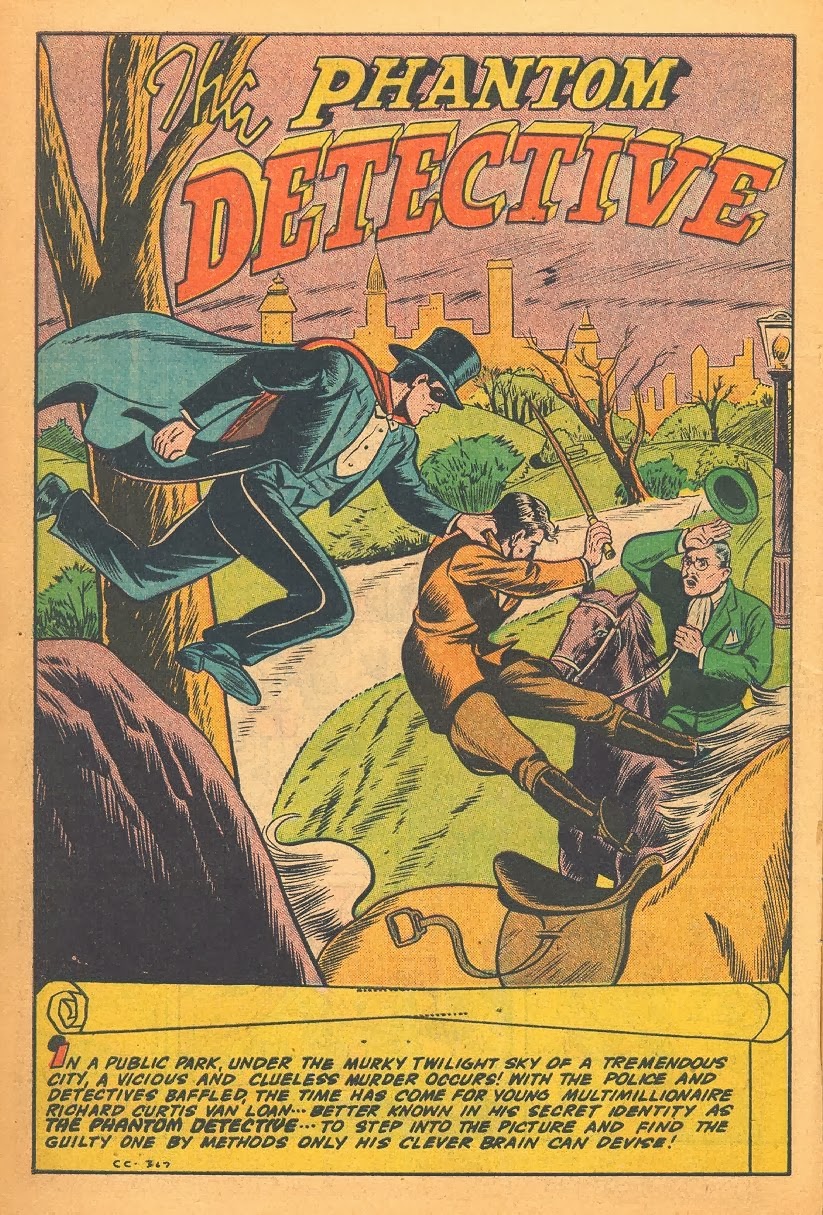
The Phantom Detective


The Phantom Detective

After the debut of The Shadow in 1931, pulp publishers were scrambling for a hero title to match The Shadow’s popularity with readers. The first to arrive on the stands was The Phantom Detective in 1933. At first, STREET & SMITH yelled lawsuit, as they thought the new character from STANDARD was a blatant rip off of their character. But before the ink was dry, POPULAR PUBLICATIONS had The Spider & Operator #5 and ACE had Secret Agent X as their leads. The pulp heroes were taking the public by storm and The Shadow was no longer alone.
Spinner Rack With Phantom Detective Pulps


Although The Phantom Detective did not have as many issues as The Shadow, it did outlast the Master of Darkness in number of years. The Shadow ran from 1931 to 1949, with 325 stories, a total of 18 years. The Phantom Detective only            had 171 issues, but lasted 20 years, from 1933 to 1953, and became the longest-running hero title in the pulp magazines.
Phantom Detective Paperback


Some even argue that The Phantom Detective actually lasted longer than the official record indicates. In 1932 STANDARD ran a serialized novel in one of their pulp magazines titled Alias Mr. Death by G. Wayman Jones (D.L. Champion). Mr. Death was merely retooled to become The Phantom Detective. If that wasn’t enough, researchers of also discovered numerous rejected Phantom Detective stories that were published as other characters, so the 171 may someday be altered. And it gets even murkier than this. One of the Doc Savage authors took his unpublished Doc Savage yarns and turned them into Phantom Detective stories. And one more curiosity, a final Phantom Detective author was also writing Shadow radio scripts, and in one of his Phantom Detective yarns he accidentally calls him The Shadow. Only in the pulps, right?
Phantom Detective Comic Book

The matinee serials, or chapter plays, at the local theaters drew upon the other media of the day for their popular cliffhangers. There were probably a dozen Zorro serials. Comic Books like Superman, Captain Marvel, Captain America, and others, were made into exciting serials; the pulp characters also had their turn at celluloid fame. The Shadow, The Spider, Tailspin Tommy, G-Men, and many others were made into serials to attract kids to the matinees. So too did the comic strips, like Flash Gordon, Buck Rogers, The Phantom, and Mandrake, and many others. When too much money was asked for the Rights to a character, the producers of serials made up their own characters. Bidding for the first Superman serial in 1940 broke down because of the money Detective Comics wanted for the Rights, so the movie that had already been planned had to change the name of the hero. From Superman, he became The Copperhead, and the serial was The Mysterious Dr. Satan. Comic strips’ The Phantom (The Ghost Who Walks) made one serial and planned a second. The producers decided against the high fee on the second, so the character was changed to Captain Africa. And yes, negotiations were rumored for a chapter play featuring The Phantom Detective, but one never appeared. However, about the time everyone expected this one to show up, a very interesting serial did appear. It was titled The Black Widow, and had all the elements of The Phantom Detective, except for, yep, The Phantom Detective. Still, he was there, even if not in name and appearance. I saw the serial either at the Gem or Tower Theater around 1947.
The Black Widow Serial


The era of the Thirties and Forties was one of the most exciting times for children and young adults looking for escapism. Though the times were harsh, the entertainment was wonderful. Pulps, comic books, picture shows, and serials truly were at the zenith of their achievements for the youth of America. Today’s entertainment, with the sex, extreme violence, and gutter language can never match those simpler times, when the world needed heroes, and children needed someone to look up to, even if they weren’t real, they could be found in their favorite form of entertainment.
Friends of The Phantom ID Card

Wednesday, January 15, 2014

The Romance Pulps


Romance Pulps

There were numerous romance pulp magazines. Early pulps included romance stories, but by the 1920’s they were given their own magazines. Many of them lasted into the early 1970’s, so they were around for a long time. Pulps were called such for the cheap pulpwood paper used to print the magazines. The slicks also published romance stories, but not to the extent the pulps did. Pulp magazines were the literature of the masses.  The following titles are just a few of the magazines available.

Ranch Romances published 884 issues from December 1924 to November 1971, possibly the longest running romance magazine during its time.

Rangeland Romances also published quite a few issues, coming in at 218 numbers, between June 1935 and December 1955.


Rangeland Love was another popular title for the ladies, coming in with 83 issues, between November 1928 and July 1934.


Some titles, like Red Star Love only came in with a few numbers, publishing 18 issues, between February 1941 and March 1942. Other titles may have surpassed Red Star Love and Rangeland Love, but some have said that the love pulps sold enough copies to support many of the magazines other titles. They were hugely popular during the pulp magazine period.